Plant Cell 3D Model
Turn this labeled plant cell around to see what sets it apart from an animal cell: a rigid cell wall, green chloroplasts, and one large central vacuole. The cutaway opens the box-shaped cell so every organelle is visible, and each part is explained below.
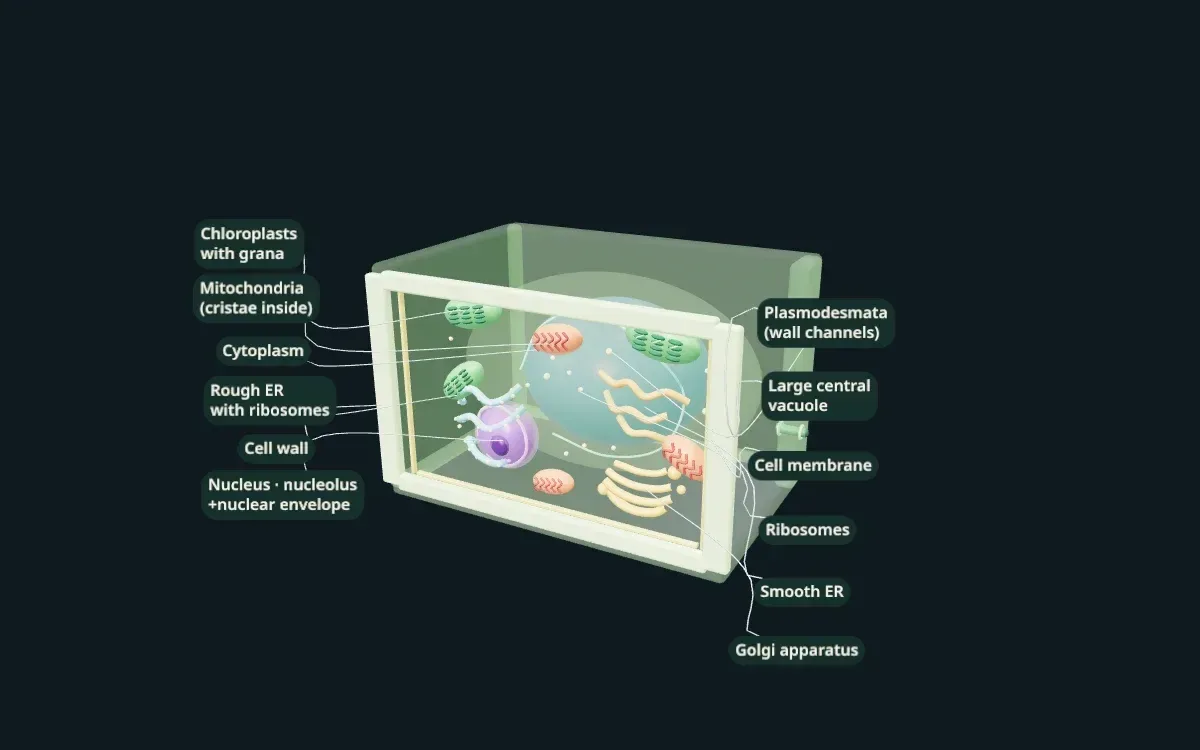
An illustrative teaching model built with Scholarly. Shapes, sizes, and colors are simplified so each part is easy to see.
Free to start. Build one from your own notes, slides, or textbook PDF.
Labeled parts
Parts of a plant cell
The 12 parts labeled on the model, and what each one does.
- Cell wall
- A rigid layer of cellulose outside the membrane. It gives the cell its box-like shape and keeps it from bursting when it takes in water.
- Cell membrane
- A thin layer just inside the wall that controls what enters and leaves the cell.
- Plasmodesmata
- Narrow channels through the cell wall that connect neighboring plant cells, so water and small molecules can pass between them.
- Chloroplasts
- Green organelles where photosynthesis turns light, water, and carbon dioxide into sugar. The stacked discs inside are called grana.
- Large central vacuole
- A big sac of water and dissolved substances. When it is full it pushes against the wall and keeps the plant firm.
- Nucleus
- Holds the cell's DNA and directs its activity. The nucleolus inside makes ribosome parts, and the nuclear envelope surrounds it.
- Mitochondria
- Release energy from sugar through cellular respiration. Plant cells need them too, even though they also make their own food.
- Rough endoplasmic reticulum
- Folded membranes covered with ribosomes, where proteins are made and folded.
- Smooth endoplasmic reticulum
- Membrane tubes without ribosomes that make lipids.
- Ribosomes
- Tiny structures that build proteins. Some float in the cytoplasm and some sit on the rough ER.
- Golgi apparatus
- Stacked sacs that modify and package proteins, and help build material for the cell wall.
- Cytoplasm
- The fluid that fills the cell around the organelles, where many reactions take place.
For class and projects
Using this model for class or a project
For studying, compare this model with the animal cell model. The three differences most tests ask about are all visible here: the cell wall, the chloroplasts, and the large central vacuole.
For a plant cell model project, use it as a reference for shape and placement. Build a rigid rectangular box for the wall, make the central vacuole take up most of the space, and push the nucleus toward one side, the way it sits in a real plant cell.
Teachers can show the model on a classroom screen and turn it while explaining photosynthesis or osmosis. If your course needs different labels, such as starch grains or the tonoplast, you can build your own version from your lesson notes.
Make your own
Need a model of your own lesson?
This model was built in Scholarly from a short description. You can build one from your own material, labeled in the words your course uses.
- 01
Add your material or describe it
Pick notes, slides, a textbook PDF, or a lecture recording, or type what the model should show.
- 02
Scholarly builds the model
In a few minutes you get an interactive 3D model with labels. A full build uses 1 AI Creation Credit, and you confirm it first.
- 03
Refine it, then use it
Ask for small changes in chat for free. On a paid plan, export a 4K picture, a turntable video, or a .glb file for slides.
FAQ
Plant cell model questions
What are the main parts of a plant cell?
The main parts are the cell wall, cell membrane, cytoplasm, nucleus, chloroplasts, large central vacuole, mitochondria, rough and smooth endoplasmic reticulum, ribosomes, Golgi apparatus, and the plasmodesmata that link neighboring cells.
How is a plant cell different from an animal cell?
A plant cell has a rigid cell wall, chloroplasts for photosynthesis, and one large central vacuole. An animal cell has none of these, has only small vacuoles, and has centrioles, which most plant cells lack.
Is this plant cell model to scale?
No. It is a teaching model. Organelles are enlarged and spread out so each one is easy to see. A real plant cell holds many more chloroplasts and mitochondria.
Can I use this model for a school project?
Yes, you can use it as a reference while you study or build a physical model. Exporting pictures or video of models you build yourself needs a paid plan.
Can I make my own 3D cell model?
Yes. Sign up, choose 3D model, and describe what you need or add your notes. Scholarly builds a labeled, interactive model in a few minutes. A full build uses 1 AI Creation Credit, and you confirm it first.
Keep exploring
More interactive 3D models
Animal cell 3D model
A labeled cutaway with the nucleus, mitochondria, ER, and Golgi.
Human heart 3D model
Four chambers, four valves, and the great vessels in a cutaway.
Human brain 3D model
The four lobes, cerebellum, and brainstem, labeled.
Human skull 3D model
The cranial and facial bones and the main sutures.
Human skeleton 3D model
The major bones of the body, labeled head to toe.
Human eye 3D model
Cornea, lens, retina, and optic nerve in a cutaway.
DNA 3D model
The double helix with its backbone and base pairs.
Atom 3D model
A carbon atom's nucleus and electron shells, Bohr style.
Solar system 3D model
The Sun and eight planets on their orbits.
3D models in Scholarly
How 3D models work, what they cost, and what they can't do yet.
Turn your notes into a 3D model
Build a labeled, interactive model of whatever you are studying or teaching, then make flashcards and a quiz from the same notes.
3D models are in Beta. A full build uses 1 AI Creation Credit; small chat edits are free.