How to Brief a Case Using Nix v. Hedden
Brief a Supreme Court opinion from the reporter pages, compare your holding with an annotated answer, and use the printable worksheet on your next assigned case.

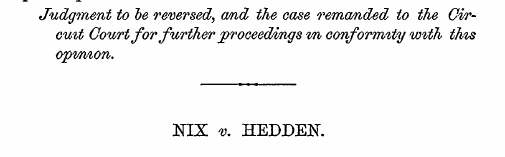
Page 304 of Nix v. Hedden contains the words “reversed” and “remanded.” If your case brief says the importers won, turn to page 307. The judgment there is affirmed. The first disposition belongs to the previous case, whose last lines share the printed page. A summary that pulls the first result from the PDF can get the winner exactly wrong.
A case brief explains what the court decided, on which facts, and why. Try this short 1893 opinion before looking at the model answers. Read the four reporter pages in the Library of Congress scan. Download the two-page case brief worksheet and answer key (.pdf).
Find the beginning and the end first
Start at the Nix v. Hedden caption partway down printed page 304. Locate the description of the suit on page 305, the trial court’s ruling on page 306 and the Supreme Court’s disposition at the foot of page 307. These three locations tell you who wanted what, who won below and whether that result survived review. Use the printed page numbers in your notes so a classmate can find the same passage in a different PDF reader.
The horizontal rule on page 304 separates the earlier disposition from the new case caption.
On paper, finish this sentence before reading further. “The importers wanted ______ because the 1883 tariff treated ______ and ______ differently.” If your answer is just “to prove tomatoes are fruit,” you still need the consequence that made the lawsuit worth bringing.
Build the brief from six entries
| Part | Model answer and reporter page |
|---|---|
| Citation | Nix v. Hedden, 149 U.S. 304 (1893). Page 304 is the first page of the case. |
| Material facts | Importers paid a duty under protest on tomatoes from the West Indies. The tariff taxed vegetables at 10% of value and listed qualifying fruits as duty-free. They sued the collector to recover the payment. Page 305. |
| Procedural history | The trial court directed a verdict for the collector. The importers sought review in the Supreme Court. Page 306. |
| Issue | Under this tariff, did the imported tomatoes fall under the vegetable duty or the fruit exemption? Pages 305–306. |
| Holding and disposition | The tomatoes were vegetables within the meaning of the 1883 tariff. The Supreme Court affirmed the judgment for the collector. Pages 306–307. |
| Reasoning | The record established no special trade meaning for the statutory terms. The Court used their ordinary meaning and cited the way tomatoes were commonly served. It acknowledged the botanical classification. Pages 306–307. |
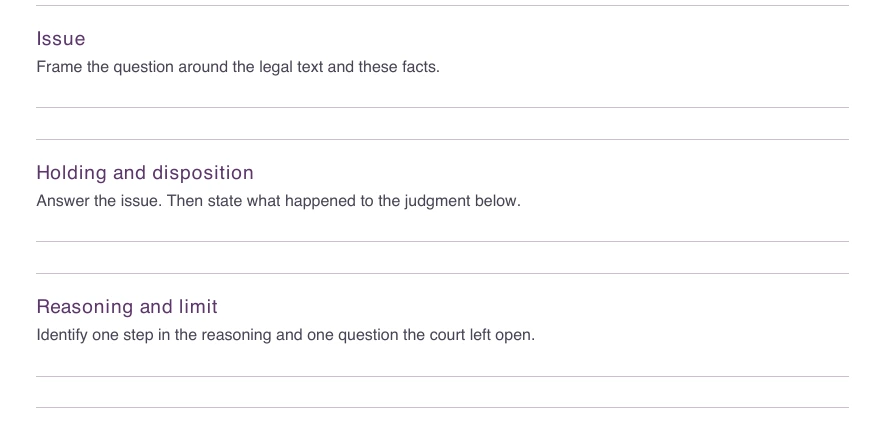
On the blank worksheet, write the holding and the disposition in separate sentences. Page two of the download has a key for checking your work.
Fix a holding that sounds plausible
First draft. “The Supreme Court ruled that tomatoes are always vegetables because cooks use them in savory dishes.”
What needs editing? “Always” extends the decision to contexts the Court never addressed. The sentence also jumps from dinner to the outcome. What made the ordinary use of the word relevant? Look at the evidence about trade usage on pages 306–307.
Revised holding. “Under the 1883 tariff, imported tomatoes fell within the vegetable provision. The Court applied ordinary usage after finding no special trade meaning for the terms in the record.”
If you use AI to review a brief, hand it your sentence and the opinion. Ask it to find the page supporting each phrase and identify any phrase broader than the decision. A page number is a lead. Open that page, check who is speaking, and see whether the passage is testimony, the Court’s reasoning, or a quotation from another case.
Prepare for the cold call
- Who won, and what did they keep? The collector won. The importers did not recover the duty through this suit.
- Why did the Court discuss how tomatoes were served? Once it used ordinary meaning, an everyday example illustrated how buyers and sellers understood the word.
- Suppose the statute expressly adopted botanical definitions. What changes? The reason for consulting everyday usage would need reexamination. That hypothetical changes the statutory text. Keep your predicted answer separate from what Nix actually held.
For your next assigned case, reuse page one of the worksheet. Before class, cover the answer to “Why?” and see whether you can reconstruct it from the material fact and the statutory words.


