DNA 3D Model
Turn this labelled double helix around to see how DNA is built: two backbones twisted around each other, held together by pairs of bases in the middle. Each base has its own colour, so you can see that adenine always pairs with thymine and guanine with cytosine.
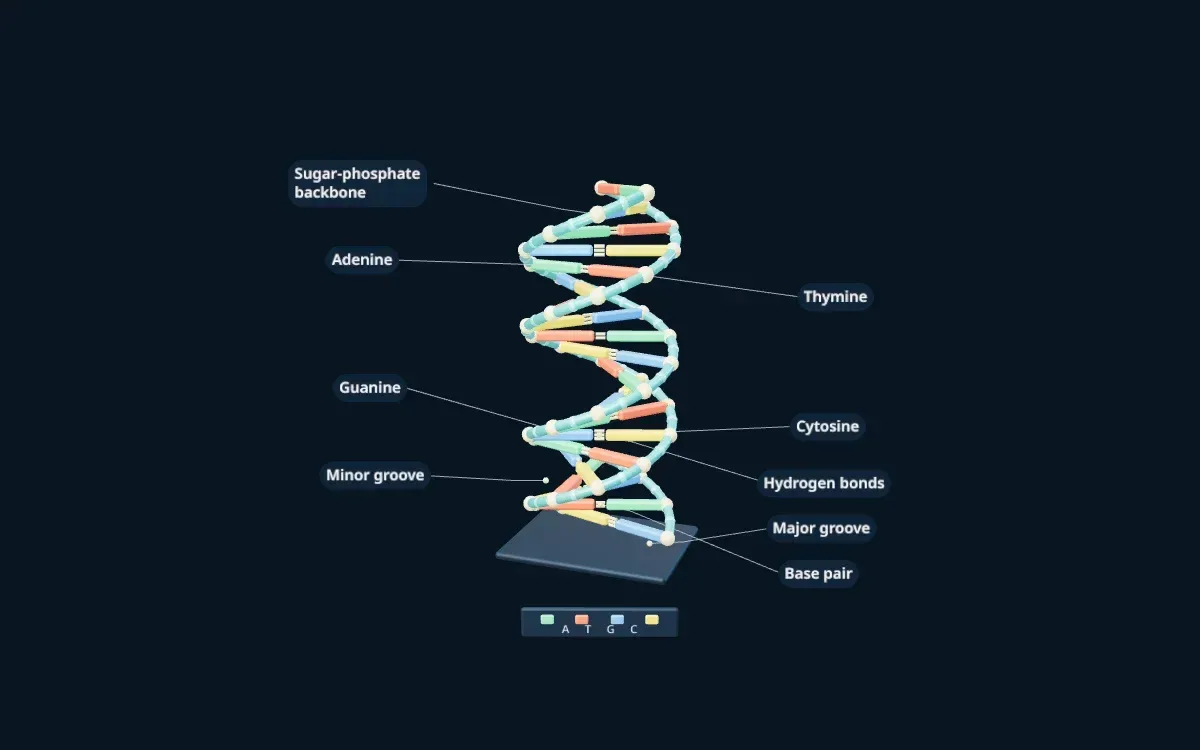
An illustrative teaching model built with Scholarly. Shapes, sizes, and colours are simplified so each part is easy to see.
Free to start. Build one from your own notes, slides, or textbook PDF.
Labelled parts
Parts of DNA
The 9 parts labelled on the model, and what each one does.
- Double helix
- The shape of DNA: two strands twisted around each other like a spiral staircase.
- Sugar-phosphate backbone
- The outer rails of the helix, made of alternating sugar (deoxyribose) and phosphate groups.
- Base pair
- Two bases, one from each strand, joined in the middle like the step of a staircase.
- Adenine (A)
- A base that always pairs with thymine.
- Thymine (T)
- A base that always pairs with adenine.
- Guanine (G)
- A base that always pairs with cytosine.
- Cytosine (C)
- A base that always pairs with guanine.
- Hydrogen bonds
- Weak bonds that hold the two bases of each pair together. A and T share two; G and C share three.
- Major and minor grooves
- The wide and narrow gaps that spiral along the helix. Proteins that read DNA often bind in the major groove.
For class and projects
Using this model for class or a project
For studying, rotate the model and check every base pair: each A faces a T and each G faces a C. That rule, called complementary base pairing, is how a cell copies DNA and the reason one strand can be worked out from the other.
For a DNA model project, use it as a reference for structure. Use four colours for the bases, make the backbones the outside rails, and give the helix a steady twist. Sweets, pipe cleaners, and beads are all common materials.
Teachers can show the model on a classroom screen while explaining replication or transcription. For a course that needs nucleotides in detail, DNA replication, or RNA, you can build your own version from your notes.
Make your own
Need a model of your own lesson?
This model was built in Scholarly from a short description. You can build one from your own material, labelled in the words your course uses.
- 01
Add your material or describe it
Pick notes, slides, a textbook PDF, or a lecture recording, or type what the model should show.
- 02
Scholarly builds the model
In a few minutes you get an interactive 3D model with labels. A full build uses 1 AI Creation Credit, and you confirm it first.
- 03
Refine it, then use it
Ask for small changes in chat for free. On a paid plan, export a 4K picture, a turntable video, or a .glb file for slides.
FAQ
DNA model questions
What are the parts of a DNA molecule?
DNA is made of nucleotides. Each one has a sugar, a phosphate, and a base. The sugars and phosphates form the backbones of the two strands, and the bases pair up in the middle, held by hydrogen bonds.
What are the base-pairing rules?
Adenine pairs with thymine, and guanine pairs with cytosine. A and T are held by two hydrogen bonds, and G and C by three.
Is this DNA model to scale?
No. It is a teaching model. The parts are simplified and enlarged so the backbone, bases, and grooves are easy to see. A real DNA molecule is about 2 nanometres wide and can be centimetres long.
Can I use this model for a school project?
Yes, you can use it as a reference while you study or build a physical model. Exporting pictures or video of models you build yourself needs a paid plan.
Can I make my own 3D DNA model?
Yes. Sign up, choose 3D model, and describe what you need or add your notes. Scholarly builds a labelled, interactive model in a few minutes. A full build uses 1 AI Creation Credit, and you confirm it first.
Keep exploring
More interactive 3D models
Animal cell 3D model
A labelled cutaway with the nucleus, mitochondria, ER, and Golgi.
Plant cell 3D model
Cell wall, chloroplasts, and the large central vacuole, labelled.
Human heart 3D model
Four chambers, four valves, and the great vessels in a cutaway.
Human brain 3D model
The four lobes, cerebellum, and brainstem, labelled.
Human skull 3D model
The cranial and facial bones and the main sutures.
Human skeleton 3D model
The major bones of the body, labelled head to toe.
Human eye 3D model
Cornea, lens, retina, and optic nerve in a cutaway.
Atom 3D model
A carbon atom's nucleus and electron shells, Bohr style.
Solar system 3D model
The Sun and eight planets on their orbits.
3D models in Scholarly
How 3D models work, what they cost, and what they can't do yet.
Turn your notes into a 3D model
Build a labelled, interactive model of whatever you are studying or teaching, then make flashcards and a quiz from the same notes.
3D models are in Beta. A full build uses 1 AI Creation Credit; small chat edits are free.