
Analysis of Epic v. Apple Anti-Steering Ruling and App Store 30% Revenue Evolution
5/1/2025
This report finished before verdicts existed. Its conclusions are in the full report.
Analysis of Epic v. Apple Anti-Steering Ruling and App Store 30% Revenue Evolution
5/1/2025
5/1/2025
This report finished before verdicts existed. Its conclusions are in the full report.
Introduction
This report examines the April 2025 ruling by the Northern District of California in the contempt proceeding of the Epic Games v. Apple “anti-steering” injunction, interpreting its immediate and longer-term implications for developers and platform competition. It then analyzes the evolution of Apple’s App Store revenue derived from its standard 30 percent commission, from 2017 through 2022, drawing on industry data and financial disclosures to illustrate trends in gross spend, commission rates, and Apple’s estimated take.
Key findings include:
1. Background: Epic v. Apple Anti-Steering Dispute
1.1 Origins of the Injunction
In September 2021, following Epic Games’ challenge to Apple’s requirement that all digital-goods transactions use Apple’s in-App Purchase (IAP) system (with a 30 percent commission), Judge Yvonne Gonzalez-Rogers ruled that Apple’s anti-steering policies violated California’s Unfair Competition Law by prohibiting developers from informing users of alternative payment methods[1][5].
1.2 2024 Compliance Allegations
Despite issuing a one-link “External Link Account Entitlement,” Apple continued charging variable commissions (12–27 percent) on off-App Store transactions, which Epic alleged amounted to a sustained effort to deter third-party payment options and preserve Apple’s revenue stream. Apple maintained it was compliant, but evidence showed that link-driven sales still funneled through Apple’s systems, triggering commissions[1].
1.3 April 2025 Contempt Ruling
On April 30, 2025, the Northern District court held Apple in “willful violation” of the 2021 injunction, finding that:
Immediate Relief and Referral for Contempt
The court enjoined Apple from:
• Charging any fees on off-App Store purchases (beyond processing costs).
• Imposing design or text restrictions on external-link presentations.
• Excluding app categories from linking.
• Displaying non-neutral messaging discouraging external purchases.
• Blocking dynamic link updates.
Criminal contempt referral to the U.S. Attorney’s Office was ordered, and Apple was sanctioned to pay Epic’s attorney fees through May 15, 2025[1].
2. Evolution of Apple’s App Store 30 Percent Commission Revenue
2.1 Gross User Spend (2017–2021)
Statista reports global App Store gross billings of:
| Year | Gross User Spend (billion USD) |
|---|---|
| 2017 | 38.7 |
| 2018 | 46.6 |
| 2019 | 55.5 |
| 2020 | 72.3 |
| 2021 | 85.1 |
Assuming a flat 30 percent commission, Apple’s estimated revenue rose from approximately $11.6 billion in 2017 to $25.5 billion in 2021 (Figure 1)[2].
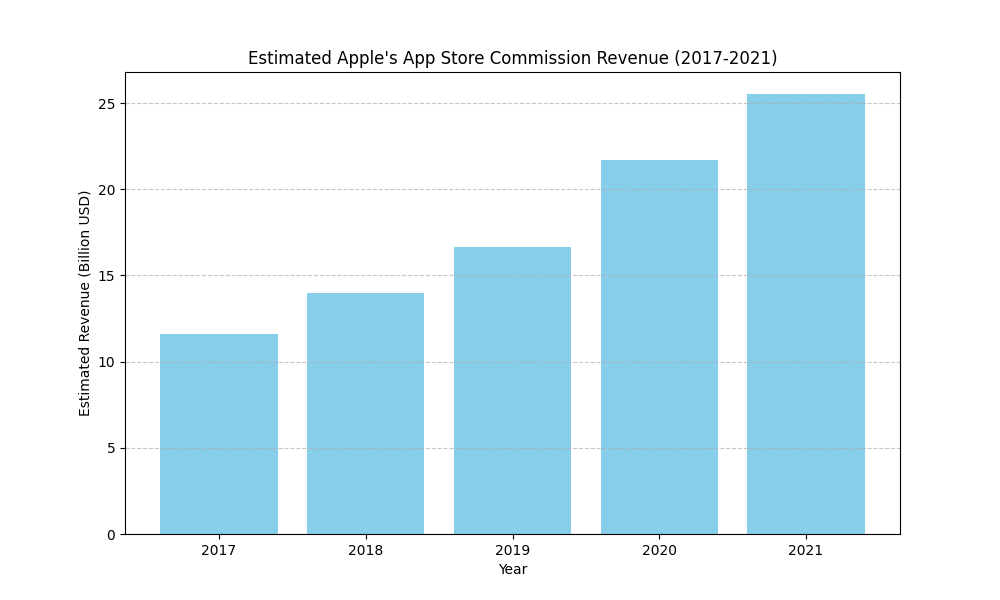
Figure 1 illustrates Apple’s commission take at 30 percent of global gross spend.
2.2 Adjusted Commission Programs
These programs reduce Apple’s effective take rate for qualifying transactions, estimated at reducing average commission closer to 25 percent overall—but precise impacts vary by developer mix[4].
2.3 2022 Developer Billings Breakdown
Apple Newsroom reported $1.1 trillion in App Store developer billings for 2022, of which $104 billion were for digital goods and services (on which Apple commissions apply)[3]. At a 30 percent rate, Apple’s estimated commission revenue in 2022 from digital goods is $31.2 billion (Figure 2).
Figure 2: Estimated Apple App Store Commission Revenue, 2022
Figure 2 calculates Apple’s 30 percent share of 2022 digital goods billings.
2.4 Trends and Implications
3. Discussion
The contempt ruling reinforces judicial authority to enforce competition-oriented injunctions against platform gatekeepers, potentially hastening industrywide shifts toward more open payment models. Simultaneously, Apple’s revenue from its standard commission, while growing substantially, faces future headwinds as reduced rates for small developers and subscriptions, combined with antitrust mandates, chip away at the nominal 30 percent level.
4. Conclusion
The April 2025 contempt finding compels Apple to comply fully with its anti-steering injunction, eliminating fees and restrictions on external-payment links. Over 2017–2022, Apple’s 30 percent commission generated an estimated $11.6 billion to $31.2 billion annually, outpacing broader App Store growth. Yet, evolving commission structures and legal constraints may alter Apple’s effective take rate going forward.
Limitations
Data on Apple’s net commission revenue after payment-processing costs is not publicly detailed. The estimated revenues assume a flat 30 percent take on gross spend; real-world effective rates vary with subscription and small-developer programs. Conflicting metrics on off-App Store link adoption rates are not fully resolved.
References
[1] “Apple ordered to stop charging fees on off-App Store purchases; referred for criminal contempt,” MacRumors, Apr. 30, 2025. URL: https://macrumors.com/2025/04/30/apple-app-store-anti-steering-injunction-violation
[2] Statista, “Global gross billings of the Apple App Store 2017–2021,” 2023. URL: https://statista.com/statistics/296226/annual-apple-app-store-revenue
[3] Apple Newsroom, “Developers generated $1.1 trillion in the App Store ecosystem in 2022,” May 31, 2023. URL: https://apple.com/newsroom/2023/05/developers-generated-one-point-one-trillion-in-the-app-store-ecosystem-in-2022
[4] Statista, “Commission rates in leading digital content stores as of August 2023,” 2023. URL: https://statista.com/statistics/975776/revenue-split-leading-digital-content-store-worldwide
[5] “Epic Games v. Apple,” Wikipedia, accessed Apr. 2025. URL: https://en.wikipedia.org/wiki/Epic_Games_v._Apple
[6] Adapty Blog, “Is the App Store revenue cut too high?,” Adapty, 2023. URL: https://adapty.io/blog/is-the-app-stores-revenue-cut-too-high-adapty-compares-it-with-other-ecosystems
No web sources in this report yet — they appear here as the research completes.