
Made with ScholarlyTurn your own files into documents like this
Adherence to Antiviral Therapy in Chronic Viral Hepatitis Patients
Factors Influencing Adherence to Antiviral Therapy in Chronic Viral Hepatitis Patients
Introduction
Antiviral therapy adherence is critical for achieving sustained virologic response and preventing long-term complications in patients with chronic viral hepatitis B (HBV) and hepatitis C (HCV). Despite the availability of highly effective therapies—nucleos(t)ide analogues for HBV and direct-acting antivirals (DAAs) for HCV—suboptimal adherence remains a major barrier to treatment success. This literature review examines studies published over the past decade to identify and synthesize factors associated with adherence. We categorize determinants into patient-related, psychological, socioeconomic, clinical, healthcare system, medication-related, and methodological factors, and summarize interventions designed to enhance adherence. Key findings include:
Overall adherence to HBV therapy is approximately 74.6%, with barriers such as forgetfulness, limited understanding of treatment importance, and routine disruption .
HCV adherence in ribavirin-containing regimens is influenced negatively by psychiatric disorders and high dosing, while HIV co-infection and higher hemoglobin levels are positive predictors .
Psychological factors—including depression and stigma—significantly impair adherence in HCV populations .
Socioeconomic status, insurance coverage, and geographic factors impact treatment initiation and adherence, particularly in underserved subgroups .
Patient–provider relationship quality and patient preferences shape adherence behaviors in HBV therapy .
Medication-related factors—regimen complexity, pill burden, and dosing frequency—affect adherence across both HBV and HCV treatments .
Measurement approaches vary widely—pharmacy claims, self-report, electronic dispensers, and plasma drug levels—each yielding different adherence estimates .
Interventions including patient education, counseling, nurse-led programs, culturally tailored messaging, and mobile health tools show promise in improving adherence, particularly when integrated into routine care .
This review synthesizes evidence across domains to inform targeted strategies for enhancing adherence and ultimately improving antiviral therapy outcomes in chronic viral hepatitis patients.
Detailed Analysis
Patient-Related Factors
1 Demographic Variables
Age, gender, and education have been investigated as predictors of adherence in both HBV and HCV populations. In studies of ribavirin-based regimens for HCV, male gender was consistently associated with higher adherence rates, whereas female patients demonstrated lower adherence trends . Younger age emerged as a barrier in integrative reviews of DAAs adherence, with younger patients exhibiting lower compliance . Educational level showed no clear, consistent impact on adherence across HCV studies but was noted as a barrier when low education coincided with limited disease and treatment knowledge .
2 Socioeconomic Status
Socioeconomic factors including employment, income, and residence influence adherence. A study in Pakistan found that rural residency correlated with higher adherence to HBV antivirals (84.25%), attributed to stronger community support and simpler lifestyles, whereas urban residents exhibited lower adherence, possibly due to competing demands and regimen complexity . In underserved African American cohorts, increased insurance coverage in the DAA era significantly improved treatment initiation and adherence (post-DAA adherence: 82% vs. 38% pre-DAA) . Unemployment and financial insecurity have been identified as adherence barriers in multiple HCV investigations .
2. Psychological Factors
1 Depression and Anxiety
Depression and anxiety are prevalent among HCV-infected individuals and have been linked to reduced adherence. A comprehensive review of HCV-related psychological distress highlighted that neurocognitive dysfunction and depression—potentially exacerbated by direct viral neurotoxicity—negatively impacted treatment compliance . Nurses face challenges in distinguishing biomedical from psychosocial causes of depression, complicating adherence interventions .
2 Stigma
HCV-related stigma—driven by public misconceptions and discrimination—undermines patients’ willingness to engage in care and adhere to medication. Studies emphasize that stigma amplifies social isolation, heightens anxiety, and hampers treatment adherence . Effective stigma reduction through education and societal engagement is necessary to foster adherence and quality of life.
3. Clinical Factors
1 Treatment Side Effects
Adverse effects remain a major deterrent to adherence. In ribavirin-based HCV regimens, higher ribavirin doses correlated with reduced adherence, likely due to dose-dependent side effects such as anemia and fatigue . DAA regimens generally present fewer side effects, yet comorbid psychiatric conditions still pose adherence challenges.
2 Comorbidities and Disease Severity
Co-infection with HIV was paradoxically associated with better adherence in HCV ribavirin studies, possibly reflecting patients’ familiarity with lifelong antiretroviral regimens . Hepatitis B-related cirrhosis severity inversely correlated with adherence benefits; long-term adherence reduced risks of decompensation (OR: 0.75) and mortality (OR: 0.70) in cirrhotic patients, underscoring the importance of sustained compliance .
4. Healthcare System Factors
1 Patient–Provider Relationship
Quality of communication and trust between patients and clinicians significantly influences adherence. A qualitative study in Australia found that clear clinician messaging, open dialogue, and shared decision-making fostered adherence in 59% of participants . Long-term adherence in cirrhosis cohorts also appeared contingent on sustained patient–provider engagement .
2 Accessibility and Insurance Coverage
Improved healthcare access—through insurance expansion, integrated mental health services, and patient navigation—enhances adherence. DAA-era African American cohorts benefited from higher insurance coverage and comprehensive care models, resulting in treatment initiation rates rising from 8.5% to 71% and adherence from 38% to 82% . Coordinated mental health and substance misuse support tripled HCV treatment uptake in systematic reviews of operational interventions .
5. Medication-Related Factors
1 Regimen Complexity and Pill Burden
Complex regimens and high pill burdens challenge adherence. In Pakistan, fixed dosing schedules improved adherence, while regimen complexity reduced compliance . In the US, guideline-recommended monotherapies (entecavir, tenofovir) doubled adherence and extended persistence (361 vs. 298 days) compared with less optimal regimens, highlighting the benefit of simplified therapy .
2 Dosing Frequency
Once-daily oral regimens are preferred; patients value efficacy and safety in conjunction with minimal dosing complexity . Frequent dosing schedules correlate with lower adherence in both HBV and HCV contexts.
6. Measurement Approaches
Adherence estimation methods yield variable rates. In HBV meta-analyses, pharmacy claims indicated the highest adherence (88.1%), compared with plasma drug levels (68.5%), self-report (69.5%), and electronic dispensers (69.8%) . Variability underscores the need for standardized, multimodal adherence assessment in research and clinical practice.
7. Interventions to Improve Adherence
1 Patient Education and Counseling
Nurse-led educational programs improved HCV treatment completion (RR 1.14) and cure rates (OR 1.93), demonstrating that structured education enhances adherence and outcomes . A culturally tailored, multicomponent RCT among Asian Americans combined virtual patient education, peer support, and patient navigation to address systemic and cultural barriers, achieving 97% retention over 12 months and targeting adherence to CHB monitoring guidelines .
2 Mobile Health Technologies
Smartphone-delivered interventions show promise for supporting the HCV care continuum. In trials using the A-CHESS platform among people with opioid use disorder, intervention participants demonstrated progression toward treatment (28% advanced care stage) compared to controls, although overall testing rates did not differ significantly . Tailored digital messaging and behavioral monitoring can bolster adherence among high-risk subgroups.
3 Psychosocial Support Systems
Peer-led and lay health worker interventions effectively promote testing, linkage, and adherence. Lay health worker-led HBV testing increased screening rates by 168% (RR 2.68), while integrated mental health services tripled HCV treatment uptake (OR 3.03) . Social support networks mitigate stigma and depression, indirectly supporting medication adherence.
Visual Representation of Adherence Rates
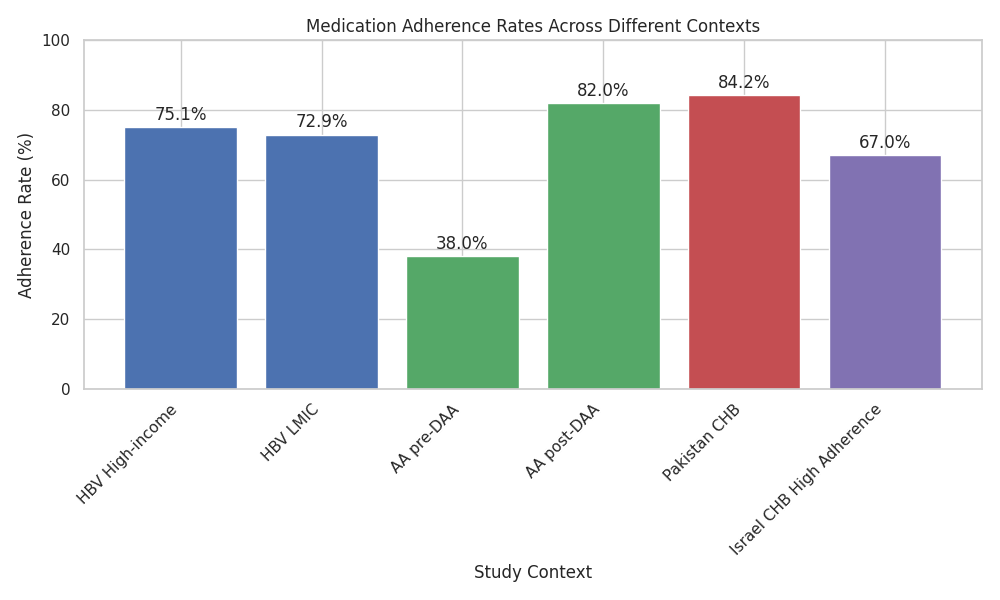
Figure 1: Comparison of observed adherence rates (%) across diverse study contexts. HBV adherence rates (high-income vs. low/middle-income), HCV ribavirin adherence (pre- and post-DAA among underserved African Americans), and CHB adherence in Pakistan and Israel.
Table 1: Factors Influencing Antiviral Therapy Adherence by Domain
| Domain | Key Factors (Positive → Negative) | Citations |
|----------------------------|----------------------------------------------------------------------------------------------|------------------------------------------------------|
| Patient-Related | Male gender ↑; Younger age ↓; Education (mixed impact) | ribavirin review |
| Socioeconomic | Insurance coverage ↑; Rural residence ↑; Unemployment & low income ↓ | DAA AA study |
| Psychological | Social support ↑; Depression & anxiety ↓; Stigma ↓ | PMC vs Frontiers |
| Clinical | HIV co-infection ↑; High-dose ribavirin ↓; Severe cirrhosis adherence benefits ↑ | ribavirin review; cirrhosis study |
| Healthcare System | Strong patient–provider relationship ↑; Clinician reminders ↑; Limited access & coverage ↓ | Qualitative; operational review |
| Medication-Related | Simplified monotherapy & once-daily dosing ↑; Pill burden & regimen complexity ↓ | guideline vs non-RT |
| Methodological Approaches | Pharmacy claims ↑; Plasma levels/moderate; Self-report & electronic dispensers moderate | HBV meta |
Table 1: Summary of principal factors affecting adherence across patient-related, socioeconomic, psychological, clinical, healthcare system, medication-related, and methodological domains.
Conclusion
Adherence to antiviral therapy in chronic HBV and HCV is multifactorial, shaped by patient demographics, psychological well-being, socioeconomic context, clinical characteristics, healthcare system interactions, and medication regimens. Measurement approaches further influence reported adherence rates. Interventions that combine patient education, culturally tailored engagement, psychosocial support, mobile health tools, and streamlined care processes offer the greatest promise for enhancing adherence. Strengthening patient–provider relationships and addressing stigma and mental health are critical. Simplifying treatment regimens—through guideline-recommended therapies—coupled with systematic adherence monitoring can improve long-term outcomes. To advance global viral hepatitis elimination targets, integrated, multilevel strategies tailored to diverse patient populations and settings are essential.
Limitations
This review synthesizes evidence exclusively from published studies; heterogeneity in study designs, populations, settings, and adherence measurement methods limits direct comparability. Some findings derive from observational cohorts and may be subject to residual confounding. Evidence for interventions is predominantly from high-income countries, underscoring the need for research in low- and middle-income contexts. Finally, literature on HCV psychosocial interventions and digital adherence tools is emerging, requiring further randomized trials to confirm efficacy.
TLDR
Chronic hepatitis B and C antiviral adherence averages ~74.6% in HBV and varies widely in HCV contexts due to demographic, psychological, socioeconomic, clinical, healthcare system, and medication-related factors. Key barriers include depression, stigma, regimen complexity, forgetfulness, and limited access, while facilitators encompass insurance coverage, simplified dosing, strong patient–provider rapport, and integrated psychosocial support. Multicomponent interventions—combining education, culturally sensitive outreach, nurse-led programs, mobile health platforms, and operational reminders—demonstrate significant adherence improvements. Standardizing measurement methods and expanding research into diverse, underserved settings will be critical to achieving WHO viral hepatitis elimination goals.