/
GEO01 CO4
Save to my account
Sign up
GEO01 CO4
Mass Wasting and Groundwater Concepts
Study
1
Question
What is mass wasting?
Answer
Mass wasting is the downhill movement of masses of bedrock, rock debris, or soil driven by the pull of gravity.
2
Question
Why is mass wasting considered one of the most easily avoidable geologic hazards?
Answer
Mass wasting can be avoided with proper planning.
3
Question
What are the controlling factors in mass wasting?
Answer
The controlling factors in mass wasting include triggers such as earthquakes, weight added to the upper part of a slope, and heavy rainfall.
4
Question
What is the driving force for mass wasting?
Answer
Gravity is the driving force for mass wasting. • Normal Force. • Shear Force. • Shear Resistance. • Shear resistance < shear force = landslide
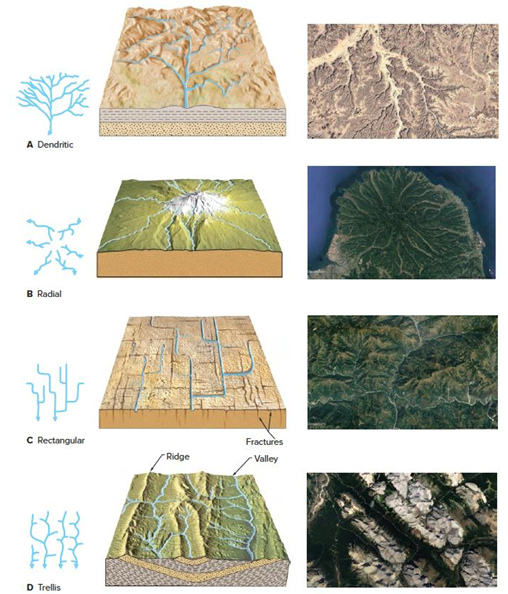
5
Question
Define shear strength in the context of mass wasting.
Answer
Shear strength refers to the resistance to movement or deformation of material.
6
Question
How does saturation of soil affect shear strength?
Answer
Saturated soil has reduced shear strength due to increased pore pressure, but a small amount of water in soil can prevent downslope movement.
7
Question
What are some triggers of mass wasting?
Answer
Triggers of mass wasting include seismic earthquake activity, heavy rainfall, construction, and lack of vegetation.
8
Question
What is a debris?
Answer
It is the unconsolidated material at Earth’s surface.
9
Question
What is creep in mass wasting?
Answer
Creep or soil creep is the very slow downslope movement of soil, influenced by factors such as water in soil and daily freeze-thaw cycles.
10
Question
What are flows and its types?
Answer
Flow is when descending mass moves downhill as a viscous fluid. 1. Earthflow 2. Solifluction 3. Debris Flow 4. Mudflow 5. Avalanche
11
Question
What is earthflow in the context of mass wasting?
Answer
Earthflow is a form of mass wasting where debris moves downslope, slowly or rapidly, as a viscous fluid.
12
Question
Describe solifluction.
Answer
Solifluction is the flow of water-saturated soil over impermeable material, commonly occurring in colder climates.
13
Question
What distinguishes a debris flow from a mudflow?
Answer
A debris flow is a flowing mixture of debris and water, while a mudflow consists only of soil and water.
14
Question
What is a debris avalanche?
Answer
Debris Avalanches are very rapid and turbulent.
15
Question
What are falls?
Answer
Falls are when material free-falls or bounces down a cliff.
16
Question
What is a rockfall?
Answer
A rockfall is the free-fall or bounce of material down a cliff, often creating an apron of fallen rock fragments (talus) at the cliff base.
17
Question
What are slides?
Answer
Slides occur when descending mass remains relatively intact, and descends along well-defined surfaces.
18
Question
Differentiate between translational slide and rotational slide.
Answer
Translational slide involves movement along a plane parallel to motion, while rotational slide (or slump) involves movement along a curved surface.
19
Question
What are rockslide and rock Avalanche ?
Answer
It is the rapid sliding of a mass of bedrock along an inclined surface of weakness.
20
Question
What are turbidity currents?
Answer
Turbidity currents are underwater landslides that can create a tsunami.
21
Question
How can landslides be prevented?
Answer
Preventing landslides can involve removing loose material, stitching slopes together (highways), constructing retaining walls with drains, and adding vegetative cover (mass wasting of soil).
22
Question
What is the hydrologic cycle?
Answer
The hydrologic cycle is the movement and interchange of water between the sea, air, and land involving processes such as evaporation (solar radiation provides energy), precipitation (rain or snow), transpiration (evaporation from plants), runoff (water flowing over land surface), and infiltration (water soaking into the ground).
23
Question
What is a stream, a type of running water?
Answer
Stream is a body of running water, confined to a channel, that runs downhill under the influence of gravity.
24
Question
What are the parts of a stream?
Answer
• Headwaters – upper part of stream near its source in the mountains. • Mouth – place where a stream enters sea, lake or larger stream. • Channel – a long, narrow depression eroded by a stream into rock or sediment. • Stream banks - sides of channel. • Streambed – bottom of the channel. • Floodplain – flat valley floor composed of sediment deposited by the stream.
25
Question
What is a drainage basin and a tributary?
Answer
Drainage basin – the total area drained by a stream and its tributaries. Tributary is a small stream flowing into a larger one.
26
Question
What is a divide and continental divide?
Answer
Divide is a ridge or high ground that divides one drainage basin from another. Continental Divide separates the streams that flow into the Pacific from those that flow into the Atlantic and Gulf of Mexico.
27
Question
What is a drainage patterns and its types?
Answer
Drainage pattern is the arrangement, in map view, of a stream and its tributaries. It is often at an acute angle. • Dendritic – drainage pattern resembling the branches of a tree. • Radial pattern – streams diverge outward like the spokes of a wheel, such as on conical mountains. • Rectangular pattern - tributaries have frequent 90° bends and join other streams at right angles. • Trellis pattern – parallel streams with short tributaries meeting at right angles.
28
Question
What factors affect stream erosion and deposition?
Answer
Factors affecting stream erosion and deposition include velocity, gradient, channel shape, roughness, and discharge.
29
Question
What is hydraulic action?
Answer
Hydraulic action is the ability of a stream to pick up and move rock and sediment.
30
Question
What is the difference between solution and abrasion?
Answer
Solution is the dissolving of rocks. Abrasion is the grinding away of stream channel by the friction and impact of the sediment load.