/
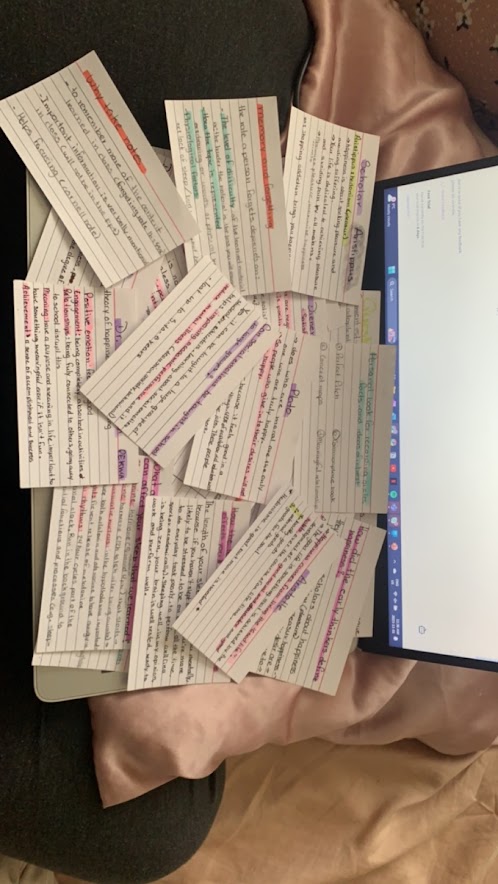
FSS1150- 200 Flashcard assignment
Clone
Register
FSS1150- 200 Flashcard assignment
Flashcard Deck
Study
Isabelle Weidemann
Canadian Olympic athlete
Beijing Olympics
She won three Olympic medals
PyeongChang Winter Olympics
Placed 6th with no medals
Extraordinary interview
She gave an extraordinary interview to the Toronto Star
Social emotional learning
She describes many aspects of social emotional learning
Practice
People would ask how she was and she would always say she was fine
Not sharing with teammates
She wouldn't share what she was doing with teammates
Pushing herself
She would push herself over the edge
Family and coach
Her family and coach Remmelt Eldering pulled her back when she pushed herself too far
Using the words in between
Her coach told her to use the words in between 'fine' and 'not fine'
Not focusing on medals
She stopped thinking about needing a medal and focused on doing her best
Finding a happy place
She found a place where she could just be happy with herself and do her best
The weird zone
She described a weird kind of zone where she doesn't hear anything and just feels the ice
Not feeling her body
She said she doesn't feel a lot of her body while skating
Goals
a) Introduce the skill of note taking b) Learn how to take good notes efficiently c) Start thinking about the paper required for this course
The Science of Memory and Forgetting
Hermann Ebbinghaus conducted the first experiments on memory from 1880-1885. He hypothesized that forgetting depends on difficulty of learned material, representation, and physiological factors such as stress and sleep.
Forgetting Curve
Ebbinghaus produced a curve widely known as the forgetting curve to demonstrate how fast we forget information over time.
Reasons to Take Notes
a) Most of the information mentioned in class won't be on the slides b) In one hour, you'll forget 44% of what you were taught c) Taking notes helps keep you focused
Student Views on Note Taking
A 2019 survey found that almost 90% of students believe note taking is necessary, less than 60% organize their notes after the lecture, less than 50% take notes for online courses, and almost 70% think note taking interferes with the lecture.
Effective Note Taking
Research shows that taking notes with pen and paper is more effective and efficient than using a computer. Pen and paper note takers remember more facts and understand concepts better.
Note Taking Strategies
The three most commonly used methods of taking notes are: 1) The Cornell Note, 2) Diagrams, and 3) Comparison charts.
The Cornell Note
Developed by Walter Pauk, the Cornell Note system helps students organize and review their notes. It includes sections for main information, keywords, and a summary.
The Commonplace Book
The commonplace book, dating back to the early 1600s, was a personal way of recording quotes, facts, and ideas. Today, apps like Obsidian can assist in retaining important information.
Making a Cornell Note
A typical Cornell note has three sections: a) wide right-hand column for information, diagrams, and pictures, b) narrow left-hand column for keywords and concepts, and c) bottom summary section for summarizing in your own words.
Deep Learning
Note taking is the first step in fostering deep learning, which leads to long-lasting acquisition of knowledge. This involves summarizing in your own words, identifying key ideas, and making connections among concepts.
Note-taking guidelines
1. Write down information in your own words. 2. Use diagrams and sketch pictures. 3. Focus on keywords, concepts, and important phrases. 4. Summarize your notes in your own words at the bottom. 5. Make connections among concepts. 6. Foster deep learning.
Benefits of Cornell Notes
- Helps take, review, and organize information. - Forces you to focus on important information. - Encourages putting things into your own words. - Enhances understanding and retention. - Useful for organizing and summarizing notes.
Diagrams and Concept Maps
- Effective way of taking notes. - Simplify and visualize information. - Aid in understanding and retention. - Illustrative diagrams and explanatory diagrams. - Concept maps organize and structure knowledge.
Concept Mapping
- Developed by Joseph Novak. - Organize and structure knowledge. - Depict connections and hierarchies. - Useful for designers, engineers, and technical writers.
The PERMA Model
- Positive emotion - Engagement - Relationships - Meaning - Accomplishments These are the five pillars of well-being.