conjunctivitis
Clone
Register
conjunctivitis
Untitled Flashcards
Study
What is Vernal keratoconjunctivitis (VKC) characterized by?
VKC is characterized by Th2 lymphocyte alteration and the exaggerated IgE response to common allergens, with a pathogenesis involving a type-I IgE-mediated hypersensitivity reaction to pollen allergens.
What is the treatment approach for Vernal keratoconjunctivitis (VKC)?
A. Topical anti-inflammatory therapy: Includes topical steroids, mast cell stabilizers, antihistamines, NSAIDs, cyclosporine, and tacrolimus. B. Topical lubricating and mucolytics: Using artificial tears and acetyl cysteine. C. Systemic therapy: Oral antihistamines and oral steroids for severe cases. D. Treatment of large papillae: Supratarsal injection of long-acting steroid, cryo application, or surgical excision. E. Supportive measures: Dark goggles, cold compresses, ice packs, and maintaining an air-conditioned atmosphere. F. Desensitization: Tried with limited success. G. Treatment of vernal keratopathy: Requires increased steroid instillation or surgical excision for large vernal plaques or shield ulcers resistant to medical therapy.
What are the predisposing factors for Vernal keratoconjunctivitis (VKC)?
1. Age and sex: More common in boys aged 4-20 years than girls. 2. Season: More common in summer, despite being labeled as 'Warm weather conjunctivitis'. 3. Climate: More prevalent in tropics, less in temperate zones, and almost non-existent in cold climates. 4. Other atopic manifestations: Associated with eczema or asthma in 40-75% of patients. 5. Family history of atopy: Found in 40-60% of patients.\
Which ages is vkc more common in?
More common in boys aged 4-20 years than girls.
What is Vernal keratopathy in Vernal keratoconjunctivitis (VKC)?
Vernal keratopathy involves corneal involvement, which may be primary or secondary due to the extension of limbal lesions. Types of lesions include: 1. Punctate epithelial keratitis: Involving the upper cornea, associated with the palpebral form, staining with rose bengal and fluorescein dye. 2. Frank epithelial erosions: Resulting from coalescence of punctate epithelial lesions, leaving Bowman's membrane intact. 3. Vernal corneal plaques: Coating bare areas of epithelial macroerosions with altered exudates. 4. Ulcerative vernal keratitis: Shallow transverse ulcer in the upper cornea, resulting from epithelial macroerosions and may lead to bacterial keratitis complications.
What are the clinical features of Vernal keratoconjunctivitis (VKC)?
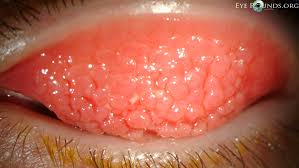
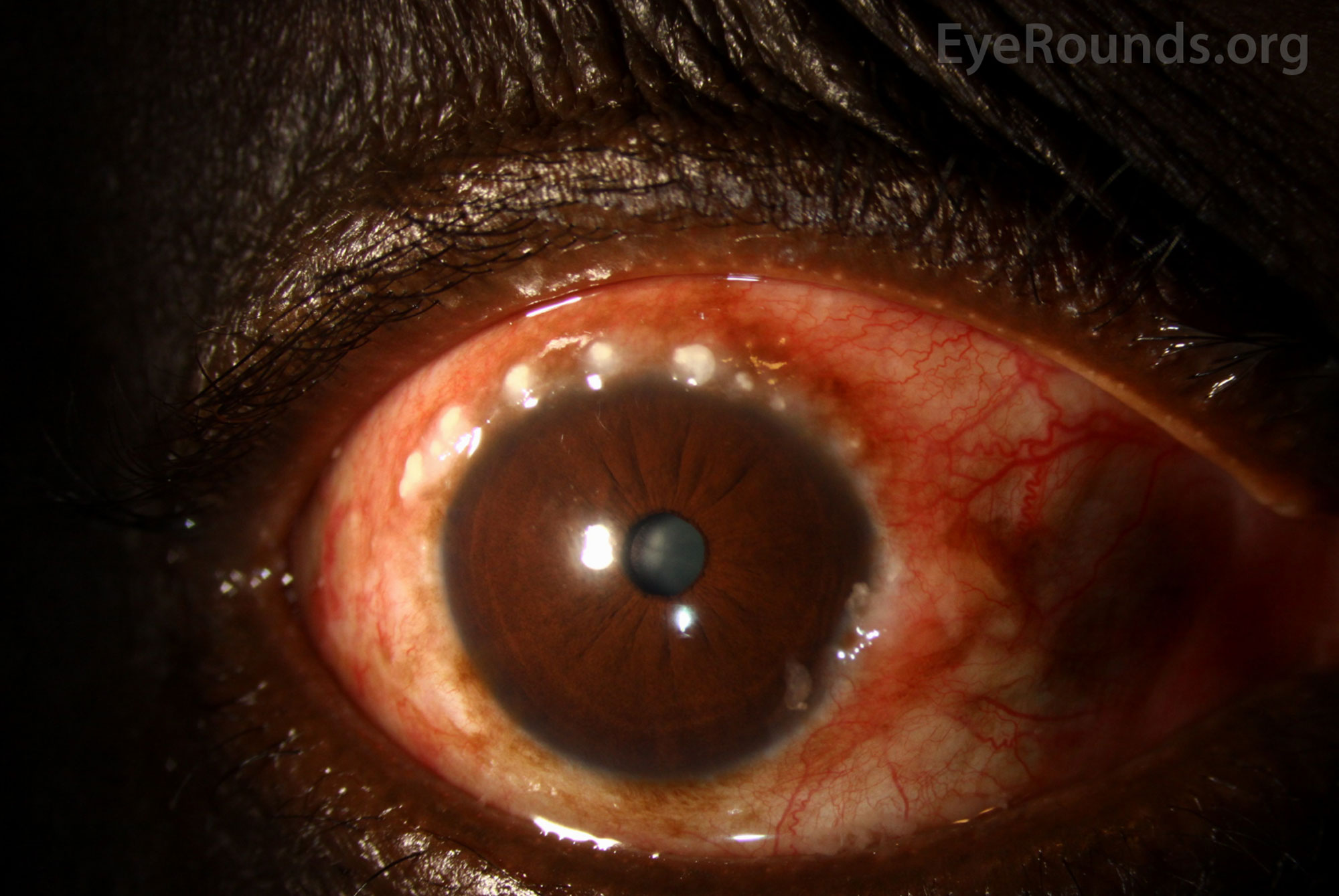
Symptoms include marked burning and itching sensation, more intolerable in warm humid atmospheres, with associated mild photophobia, lacrimation, stringy ropy discharge, and heaviness of lids. Signs include: 1. Palpebral form: Hard, flat-topped papillae in a 'cobble-stone' or 'pavement stone' fashion with conjunctival hyperemia. 2. Bulbar limbal form: Dusky red triangular congestion of bulbar conjunctiva, limbal papillae, and discrete whitish raised dots along the limbus (Horner-Tranta's spots). 3. Mixed form: Combined features of both palpebral and bulbar forms.
What are the pathological changes seen in Vernal keratoconjunctivitis (VKC)?
1. Conjunctival epithelium: Contains a large number of mast cells, eosinophils, undergoes hyperplasia, and sends downward projections into the subepithelial tissue. 2. Adenoid layer: Shows marked cellular infiltration by mast cells, eosinophils, plasma cells, lymphocytes, and histiocytes. 3. Fibrous layer: Shows proliferation which later undergoes hyaline changes. 4. Conjunctival vessels: Show proliferation, increased permeability, and vasodilation, leading to the formation of multiple papillae in the upper tarsal conjunctiva.
what are the 3 clinical forms of spring catarrh.
Palpebral, limbal, and mixed.
what is the typical lesion seen in the palpebral form
papillae arranged in cobble stone or pavement stone . conjuctival hyperemia, giant papillae
lesion seen in limbal form of spring catarrh
Horner-Trantas dots, Limbal papillae occur as gelatinous, thickened confluent accumulation of tissue around the limbus
which form of vkc show this
giant papillae seen in palpebral form
what is the defect and which condition shows this
Limbal vkc
Pathology of vkc
Untitled Flashcards
Study
What constitutes the secondary prevention against trachoma?
The use of antibiotics
What are the advanced laboratory tests employed for research purposes only in the laboratory diagnosis of trachoma?
1. Conjunctival cytology. 2. Detection of inclusion bodies in conjunctival smear. 3. Enzyme-linked immunosorbent assay (ELISA) for chlamydia antigens. 4. Polymerase chain reaction (PCR). 5. Isolation of Chlamydia by yolk-sac inoculation method and tissue culture technique. 6. Serotyping of TRIC agents by detecting specific antibodies using microimmunofluorescence (micro-IF) method.
What is the causative organism of Trachoma?
Trachoma is caused by the bacterium Chlamydia trachomatis, biovar TRIC. The organism is epitheliotropic and produces intracytoplasmic inclusion bodies called HP bodies (Halberstaedter Prowazek bodies).
What is the treatment for conjunctival xerosis in Stage TS of trachoma?
Conjunctival xerosis should be treated with artificial tears lubricating drops in Stage TS of trachoma.
What type of immune response is elicited in the cicatricial phase of trachoma due to recurrent infections with chlamydial antigen?
A chronic immune response consisting of cell-mediated delayed hypersensitivity Type IV reaction is elicited in the cicatricial phase of trachoma due to recurrent infections with chlamydial antigen.
What is cicatrization in the late stages of Trachoma?
In late stages, Trachoma presents with cicatrization, giving a rough appearance.
What is pannus formation in Trachoma?
Pannus formation is a characteristic feature of Trachoma.
What are concretions in the context of the cicatricial phase of trachoma and how are they formed?
Concretions in the context of the cicatricial phase of trachoma are hard-looking whitish deposits varying in size from pin-point to 2 mm. They are formed due to the accumulation of dead epithelial cells and inspissated mucus in the depressions called glands of Henle.
What are the stages of trachoma in the WHO classification that constitute the inactive trachoma?
Stages TS, TI, and CO of the WHO classification constitute the inactive trachoma. In these stages, infection is no longer present, only trachoma sequelae are present.
How is Trachoma characterized in terms of conjunctiva tissue response?
Trachoma is characterized by a mixed follicular and papillary response of conjunctiva tissue.
What are the environmental sanitation measures recommended for primordial prevention of trachoma?
- Provision of water latrines and good water supply to reduce flies and improve washing habits - Refuse dumps - Sprays to control flies - Keeping animal pens away from human households - Health education to improve personal and environmental hygiene
How should trichiasis be treated in Stage TI of trachoma?
Trichiasis, which is a few misdirected cilia, should be treated with permanent lash removal measures such as electrolysis, cryolysis, and radiofrequency epilation in Stage TI of trachoma.
What is the main source of infection in trachoma endemic areas?
In trachoma endemic areas, the main source of infection is the conjunctival discharge of the affected person. Superimposed bacterial infections help in transmission by increasing the conjunctival secretions.
What are the current WHO recommendations for community-based mass antibiotic therapy in areas with high prevalence of trachoma?
- Oral azithromycin single dose of 20 mg/kg up to 1 g for all community members - Tetracycline eye ointment twice daily for 6 weeks for pregnant women, children 6 months and those allergic to macrolides - Annual mass antibiotic therapy for continuous three years
What are the modes of infection for Trachoma transmission?
Infection may spread from eye to eye through direct spread via contact, airborne or waterborne modes. Vector transmission through flies and material transfer via contaminated fingers of healthcare workers, common items like towels and handkerchiefs, and surma-rods also play a role in the spread of Trachoma.
What are the critical measures for primary prevention of trachoma related to facial hygiene?
Frequent face wash with clean water, avoidance of common use of towel, handkerchief, surma-rods, etc.
What is one of the leading causes of preventable blindness in the world?
Trachoma is still one of the leading causes of preventable blindness in the world.
features of trachoma
Trachoma features include eye discharge, swollen eyelids, trichiasis (in-turned eyelashes), corneal opacity, and scarring of the inner eyelids.
What are the four stages of trachoma according to McCallan in 1908?
Stage I: Incipient trachoma or stage of infiltration. It is characterized by hyperemia of palpebral conjunctiva and immature follicles. Stage II: Established trachoma or stage of florid infiltration. It is characterized by appearance of mature follicles, papillae, and progressive corneal pannus. Stage III: Cicatrising trachoma or stage of scarring. It includes obvious scarring of palpebral conjunctiva. Stage IV: Healed trachoma or stage of sequelae. The disease is quiet and cured but sequelae due to cicatrization give rise to symptoms.
How should concretions be treated in Stage TS of trachoma?
Concretions should be removed with a hypodermic needle in Stage TS of trachoma.
Where does the word 'Trachoma' originate from and what does it mean?
The word 'Trachoma' comes from the Greek word for 'rough', describing the surface appearance of conjunctiva in chronic Trachoma.
What constitutes active trachoma in the WHO classification and what is the mainstay of treatment?
Active trachoma Stage TF & TI of WHO classification constitutes active trachoma in which acute infection is present, and therefore treatment is directed at eliminating the chlamydia organism. Antibiotics constitute the mainstay of treatment of active trachoma.
What are Herbert pits in the context of the corneal signs of trachoma and how are they described?
Herbert pits are oval or circular pitted scars left after the healing of Herbert follicles in the limbal area, as observed in the corneal signs of trachoma.
What are the topical therapy regimes for active trachoma treatment?
Topical therapy regimes for active trachoma treatment consist of Tetracycline 1% or erythromycin 1% eye ointment twice daily for 6 weeks
How can active trachoma with follicular hypertrophy be differentiated from acute adenoviral follicular conjunctivitis (EKC)?
Distribution of follicles in trachoma is mainly on upper palpebral conjunctiva and upper fornix, while in EKC lower palpebral conjunctiva and lower fornix are predominantly involved. Associated signs such as papillae and pannus are characteristic of trachoma.
What are the clinical features of trachoma described in two phases?
Phase of active trachoma usually occurs during childhood due to active chlamydia infection. Incubation period of active trachoma varies from 7 to 14 days. Onset of disease is usually insidious subacute. Symptoms of active trachoma in the absence of secondary infection include mild foreign body sensation, occasional lacrimation, slight stickiness of the lids, and scanty mucoid discharge. In the presence of secondary bacterial infection, discomfort, foreign body sensation, blurring of vision, mild photophobia, mucopurulent discharge.
What is the primary area affected by Trachoma?
Trachoma primarily affects the superficial epithelium of conjunctiva and cornea simultaneously.
What does a Giemsa-stained smear showing a predominantly polymorphonuclear reaction with the presence of plasma cells and Leber cells suggest in the laboratory diagnosis of trachoma?
A Giemsa-stained smear showing a predominantly polymorphonuclear reaction with the presence of plasma cells and Leber cells is suggestive of trachoma.
What are the predisposing factors for Trachoma?
Predisposing factors for Trachoma include age (usually contracted during infancy and early childhood), sex (preponderance in females), race (common in Jews, less common among Negroes), climate (more common in areas with dry and dusty weather), socioeconomic status (more common in poor classes with unhygienic living conditions), and environmental factors like exposure to dust, smoke, irritants, and sunlight.
What are the corneal signs of active trachoma?
1. Superficial keratitis may be present in the upper part of the cornea. 2. Herbert follicles refer to typical follicles present in the limbal area, similar histologically to conjunctival follicles. 3. Progressive pannus, characterized by infiltration of the cornea associated with vascularization in the upper part. The vessels are superficial and lie between the epithelium and Bowman's membrane. Pannus in active trachoma is progressive, with infiltration of the cornea ahead of vascularization. Corneal ulcers may develop at the advancing edge of pannus, usually shallow and may become chronic and indolent.